
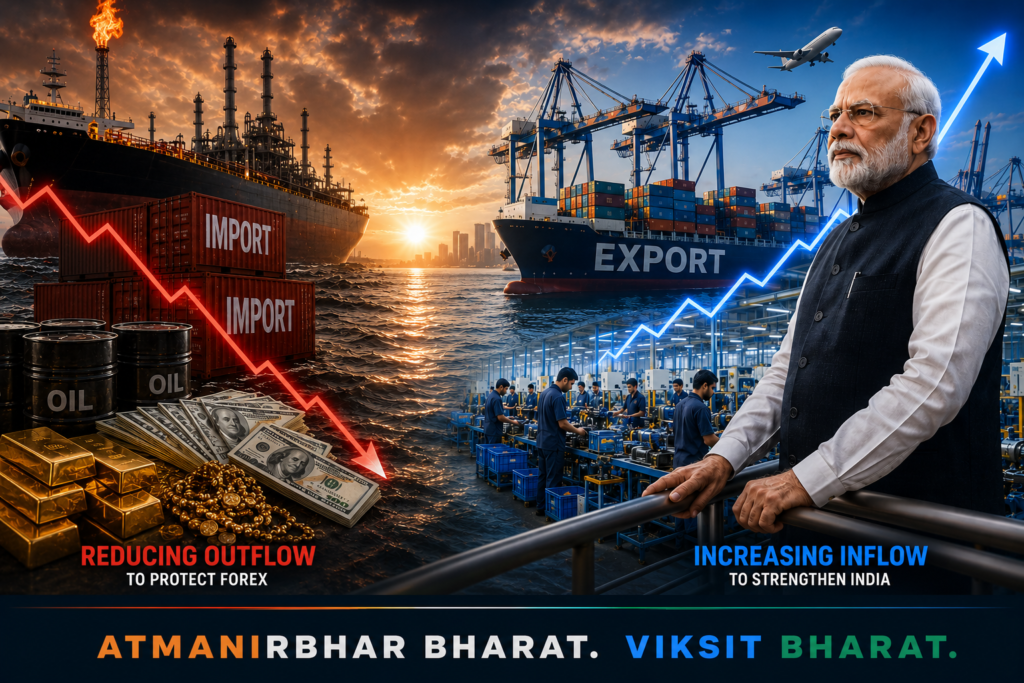
In a recent address to the nation, Prime Minister Narendra Modi highlighted a critical challenge facing our economy: the urgent need to conserve India’s foreign exchange (forex) reserves.
Amidst rising oil prices and global market uncertainty, the PM called for a collective effort to stop the “leakage” of our national wealth. He suggested several immediate steps for citizens and businesses:
-
Reducing petrol and diesel consumption through carpooling and public transport.
-
Reviving Work-From-Home (WFH) to cut down on unnecessary commuting.
-
Postponing gold purchases and reducing dependence on imported fertilisers and edible oils.
While these measures are a vital defensive shield, they reveal a much deeper story about how India’s economy actually breathes.
The Reality: India Cannot Run Without Imports
We have to be honest—India is currently import-dependent in several key sectors due to our geographical and industrial reality. We aren’t just buying these things out of choice; we are buying them to survive and grow.
The Energy Gap: We do not have enough domestic crude oil. To keep our factories running and logistics moving, we must pay in US dollars to bring energy into the country.
The Fertilizer Trap: Agriculture is our largest sector, but it creates a “double hit” on our economy. We spend foreign dollars to import fertilizers, and then the government spends domestic tax money to subsidize them for farmers. It’s a massive drain on both ends.
The Gold Paradox: We have very little natural gold in India, yet our cultural demand is massive. When we buy gold, it is essentially a “dead asset.” Billions of dollars leave our borders, only for that metal to sit idle in a locker. It doesn’t build roads, start factories, or create a single job.
From electronics and chemicals to industrial machinery and high-end technology, these imports are the “rent” we pay to remain a growing global player.
The Two Sides of the Coin
The PM’s call to conserve reserves is a necessary move during a crisis, but we must look at the other side of the coin. Can a growing economy permanently survive by only reducing consumption?
As India grows, our fuel demand will grow. Our infrastructure and industrial needs will expand. Daily consumption will rise. You cannot run a world-class economy on a diet of restriction. If we only focus on “saving,” we are merely playing defense—trying to curl up and squeeze our legs to fit a small blanket.
The truth is, even if we reduce usage, our forex requirements will eventually expand because our growth is unstoppable. The answer isn’t just to stop spending; it’s to start earning more.
The Offense: Turning MSMEs into Export Powerhouses
The real long-term solution is not just reducing forex outflow; it is dramatically increasing forex inflow. The strongest answer to that is EXPORTS.
This is where Indian MSMEs must step forward and take responsibility. Every time an MSME transitions from a domestic supplier to a global exporter, the entire nation wins. An exporting MSME:
-
Creates grassroots jobs that aren’t dependent on local demand alone.
-
Strengthens manufacturing by meeting world-class competitiveness standards.
Making the Blanket Bigger
India already has the manufacturing capability. The challenge is converting that manufacturing strength into EXPORT strength. This requires more than just a good product—it requires compliance readiness, operational structuring, market intelligence, and global execution support.
At ProSca, we believe that long-term economic resilience won’t come from consuming less of what we need. It will come when we build thousands of globally competitive MSMEs.
The answer cannot always be shrinking ourselves to fit the blanket; the real solution is making the blanket bigger.